

If you’ve ever twisted an ankle on a trail, stepped off a curb wrong, or landed awkwardly during a run, you know the sharp sting that follows. Most runners brush it off as “just a sprain.” But here’s the truth: there’s no such thing as just a sprain.
Ankle sprains are one of the most common running injuries, and if you don’t rehab them properly, they’re also one of the most likely to come back. Left untreated, they can turn into chronic instability, repeat injuries, and even set off a chain reaction of pain in your knees, hips, and back.
What Actually Happens in an Ankle Sprain?
Your ankle is stabilized by strong ligaments that connect bone to bone. The most common running sprain is an inversion sprain, where the foot rolls inward and stretches or tears the ligaments on the outside of the ankle.
-
Grade I (Mild): Ligaments are stretched, but not torn. Pain and mild swelling.
-
Grade II (Moderate): Partial tear of one or more ligaments. Noticeable swelling, bruising, and difficulty walking.
-
Grade III (Severe): Complete tear of a ligament. Major swelling, bruising, and instability, sometimes requiring surgery.
Even a mild sprain disrupts the tiny sensors (proprioceptors) in your ankle that tell your brain where your foot is in space. Without retraining, your ankle remains vulnerable to re-injury.
Spiritual Reflection: What Happens When Your Foundation Gives Out?
The ankle is symbolic of support, direction, and trust in your path.
When you sprain it, the injury often mirrors a moment in life when:
-
your footing felt uncertain,
-
you moved too quickly through something that needed intention, or
-
you ignored early signs that you needed to slow down.
It’s a literal pause, a forced recalibration. Your body asking, Are you moving in alignment, or just moving?
Journal Prompt: Where in my life have I been feeling unsteady or unsure? And where have I been ignoring the signals to slow down and move with more intention?
Why Runners Should Take Sprains Seriously
Your ankles absorb the first impact of every stride. When they’re weak or unstable:
-
Your biomechanics shift. Foot strike changes, which can stress the knees and hips.
-
Your risk of other injuries increases. Shin splints, knee pain, and hip issues often trace back to ankle instability.
-
Performance suffers. If you can’t trust your landing, your stride shortens and efficiency drops.
Spiritual Reflection: Learning to Trust Your Steps Again
A sprained ankle teaches you something subtle but profound:
Trust isn’t automatic, it’s rebuilt.
You realize how much confidence is woven into something as small as landing on one foot. When that trust is disrupted, a part of you learns to be more intentional, more aware, more present with each step, both on the run and in life.
Journal Prompt: What would it look like to slow down enough to trust my own footing again: physically, emotionally, or spiritually?
Rehab Basics for Ankle Sprains
- Phase 1: Calm the Storm (First 48-72 hours)
-
Protect and rest the joint.
-
Ice 15–20 minutes at a time.
-
Compression wrap or sleeve to manage swelling.
-
Gentle ankle circles or writing the alphabet in the air to keep mobility.
-
- Phase 2: Restore Motion & Strength (After a Few Days)
-
Gradual weight-bearing as tolerated.
-
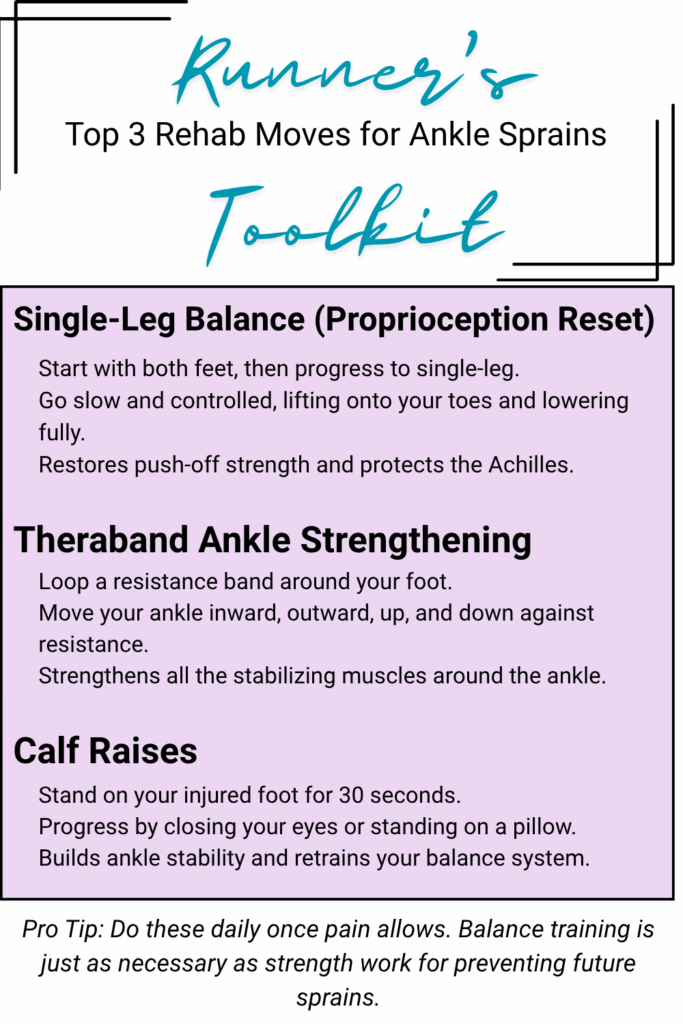
Calf raises and theraband ankle exercises.
-
Begin single-leg balance drills (first on stable ground, then progress).
-
- Phase 3: Train the Brain & Return to Sport
-
Wobble board or foam pad balance work.
-
Agility drills (side steps, hops, short jogs).
-
Gradual return-to-run program (start with walk/run intervals).
-
Pro Tip: Proprioception Is the Secret Weapon
After a sprain, the ligaments don’t just weaken, your body’s ability to sense where your ankle is in space also takes a hit. That’s why balance training is non-negotiable. Single-leg drills, eyes-closed balance, and unstable surface work are what prevent repeat sprains.
Spiritual Reflection: Relearning Your Place in the World
Proprioception is your body’s internal compass, the whisper that guides your movement without you thinking.
When it’s disrupted, life often mirrors that feeling:
Where am I? What direction am I supposed to take? Why do I feel off balance?
Rehab becomes more than physical retraining.
It becomes reconnection, to self, to intuition, to the small signals you may have been overriding.
Healing your ankle is, in its own way, healing your ability to feel where you are and trust it.
How Long Until You Can Run Again?
-
Mild sprain: 1-3 weeks.
-
Moderate sprain: 3-6 weeks.
-
Severe sprain: 8-12 weeks, sometimes longer.
The biggest mistake runners make? Returning to running too soon. Let your ankle heal fully, and it will repay you with long-term stability.
The Pause You Didn’t Want, but Probably Needed
Runners hate slowing down, but injuries often happen in the moments when life needs your attention elsewhere. A sprain asks you to be still long enough to rebuild your foundation.
Sometimes the pause isn’t punishment. It’s protection.
Takeaway
An ankle sprain may feel like a temporary setback, but it’s actually an invitation, a chance to strengthen your foundation and prevent bigger injuries down the road. Take it seriously, do the work, and your ankles will carry you many more miles with confidence.
✨ Next in this series: Plantar Fasciitis, When Every Morning Step Hurts